

Six Most Tasty Invasive Species

Invasive plants here in Hawai’i suck. Because Hawai’i’s unique ecosystem evolved without grazing mammals, native plants evolved to grow less quickly and less aggressively. Thus, native Hawaiian plants are already at a disadvantage to plants from other environments, which have evolved to be much more aggressive. This is not the fault of the plants themselves, yet the detrimental effect of invasive plant species on native ones is undeniable. Plants like Strawberry Guava and Miconia grow extremely fast and quickly form thickets, preventing the sun from reaching the ground. Plants like Himalayan Ginger and Eucalyptus pump biochemicals into the ground through allelopathy, hindering the growth of any other species around them. And plants like Fountain Grass and Buffelgrass, which have evolved to spread through fire, unsurprisingly encourage fires to happen, by growing densely and becoming extremely dry in droughts. In all environments, even the most pristine native forests, have the threat of aggressive invasive plants hanging over their heads.
I’ll say it again. Invasive plants suck. Luckily, many people in our state think so too, and organizations like Big Island Invasive Species Council do great work in removing invasive plants from the landscape. Additionally, a large proportion of state-funded and non-profit conservation organizations around the island have time and resources directed right at removing invasive plants.
You may ask, now that we have this knowledge, what can we do to help protect our precious native species? One of the most important things is to do your research on plants before you plant them outside. Websites like plantpono.org will tell you whether or not your chosen plant is a good idea to plant. Another very important thing to do is to volunteer with local conservation organizations that host workdays focusing on invasive plant removal.
Now, a small solution is eating invasive species. Believe it or not, even though these plants are horrible for native ecosystems, some have great eating potential. Eating invasive species does, in fact, help the spread to some degree. As you will see, eating fruit from some plants takes some seeds out of the environment. Though it is just a drop in the bucket, I'd say it’s better to take some pressure off native plants than to do nothing at all. And anyway, you’ll find that there are some delicious plants out there.
That being said, here is a list of some of the tastiest invasive species.
Himalayan Ginger (Hedychium gardnerianum) Honeysuckle
Though this plant sometimes goes by the name of “Kahili Ginger,” don’t let it fool you - this plant is actually native to the Himalayas in Nepal, Bhutan, and India. Himalayan ginger was introduced to Hawai’i in the early 19th century as an ornamental plant. It quickly escaped cultivation, and today, it can commonly be seen growing as thickets in wet forests.
Kahili ginger flowers have a delicious nectar in them that can be sucked out like honeysuckles. (Fun fact: my profile picture features me feasting on some.) Simply take an open flower, carefully pull it away from the green sepal, take off the hard tip of the flower, and suck on the tubular side of the flower. It’s fun and tasty!
(Forest & Kim Starr)
Strawberry Guava (Psidium cattleyanum)
Strawberry Guava is a small tree that grows in wet areas in Hawai’i. It was introduced in the 1800s for ornamental and edible purposes, but it quickly escaped cultivation. Its seeds are spread by birds and pigs who eat the fruit and carry them further into native forests. Strawberry guava grows in impenetrable thickets, preventing the sun from reaching native plants. Strawberry guava fruits are small and pretty tasty; they unsurprisingly taste as if a strawberry plant and a guava tree had a baby. Though they’re tasty by themselves, I personally like to cook them down and make strawberry guava jam.
(Forest & Kim Starr)
Common Guava (Psidium guajava)
Though Common Guava looks similar to Strawberry Guava, the leaves and fruit are slightly different. Common guava leaves are larger and have distinct dimples, and their fruit is yellow and typically larger than their cousins. Common guava is slightly less invasive than Strawberry Guava because it forms less impenetrable thickets, but it is still highly aggressive and easily outcompetes native species. Its fruit, though larger, is slightly more tart (though it depends on the tree), but has a great floral flavor.

(Forest & Kim Starr)
Koster’s Curse (Miconia Calvescens)
Not many know that Koster’s Curse berries are edible. And, I think it’s a shame because they are pretty tasty (similar to a blueberry). Koster’s Curse is native to Central and South America. It was first observed in Hawai’i in the 1940s and has since spread to every island. Koster’s Curse is a highly aggressive and shade-tolerant plant growing in forest understories and in open, disturbed areas. Each tiny fruit contains roughly 500 seeds, which are spread by birds and pigs. Its tiny seeds are also spread by hikers, as smashed berries easily lodge seeds into the grooves of hikers' shoes. So, not only do Koster’s Curse berries taste good, but eating them means taking at least 500 seeds out of the environment! There are many look-alikes to Koster’s Curse, so be cautious. However, a defining feature is lots of tiny hairs on the leaves and fruit of this plant.
(Forest & Kim Starr)
Kiawe (Neltuma pallida)
Not many people know that Kiawe, too, is edible. And, you may not even know that Kiawe is not native and was introduced in 1828 by Father Bachelot in Oahu. But, you probably know how much of a nuisance Kiawe can be, getting stuck in your foot and making your day a little bit worse. And maybe you’ve noticed that Kiawe produces long yellow bean pods. These pods are edible and very versatile once ground up into flour. I really recommend checking out this website, in which Vince Dodge talks about how to harvest and prepare Kiawe.
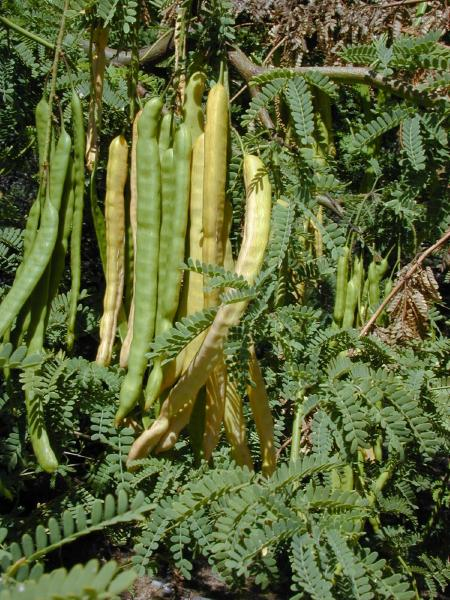
(Forest & Kim Starr)
Loquat (Eriobotrya japonica)
Loquat is a 15-30-foot tree native to China. It produces small yellow-orange fruits, which have 4-5 large seeds surrounded by sweet and tart flesh. It was introduced in the 1800s by Chinese immigrants and is commonly grown for its fruit. Unfortunately, loquat has naturalized in the wetter parts of Hawai’i, like at Kalōpā state park, and is considered invasive, as it grows aggressively and shades out native species. By eating its fruit, you can prevent seeds from entering the environment and spreading further.
Pro tip: Pick the softer, darker fruits, as the lighter ones can be pretty sour.
(Forest & Kim Starr)


Those look yummy!