

Native Plant Highlight: Kōlea Lau Nui (Myrsine lessertiana)

The plant for this native plant highlight is the beautiful Kolea Lau Nui, Myrsine lessertiana.
Plant Description
Kōlea Lau Nui is an endemic tree that grows in dry, mesic, and, more commonly, wet forests at elevations between 700 and 4,000 feet. It grows on all of the main Hawaiian islands. Kōlea Lau Nui can reach heights of 60 feet, but are usually found growing shorter than this. They typically grow very straight and have light gray bark. They have dark green leaves, though their liko (new growth) is typically a bright and deep pink to purple, and are a beautiful sight en masse. Kōlea Lau Nui flowers are green-tinged or purple, and emerge from the tree’s stems from fall to spring. Its fruits ripen to a deep purple.

Credit: Kai Garcia-Tobar

Flowers - Credit: Forest & Kim Starr
Scientific Roots
Species in the genus Myrsine are found nearly worldwide, though most notably in the tropics and subtropics. Kōlea Lau Nui is one of 19 Myrsine species endemic to Hawai’i, and is probably the most common species. Hawaiian Myrisine species are unique in that they are monophyletic, meaning all 19 species in Hawai’i likely evolved from a single species introduced to these islands thousands of years ago. Though it is not known where Kōlea Lau Nui’s ancestor came from, it is likely that the seeds of its ancestor were carried by a bird’s poop.
Ecology
Though there is little information to be found online, it is likely that Kōlea Lau Nui’s fruits are or were eaten by still-existing or extinct Hawaiian berry-eating native birds. Kōlea Lau Nui stabilizes soil, provides leaf litter to build up soil, and provides crucial mid-story habitat to native species. Kōlea Lau Nui is a good species for forest restoration, as it is able to grow in low-elevation forests with low light and high moisture, as well as at elevation.
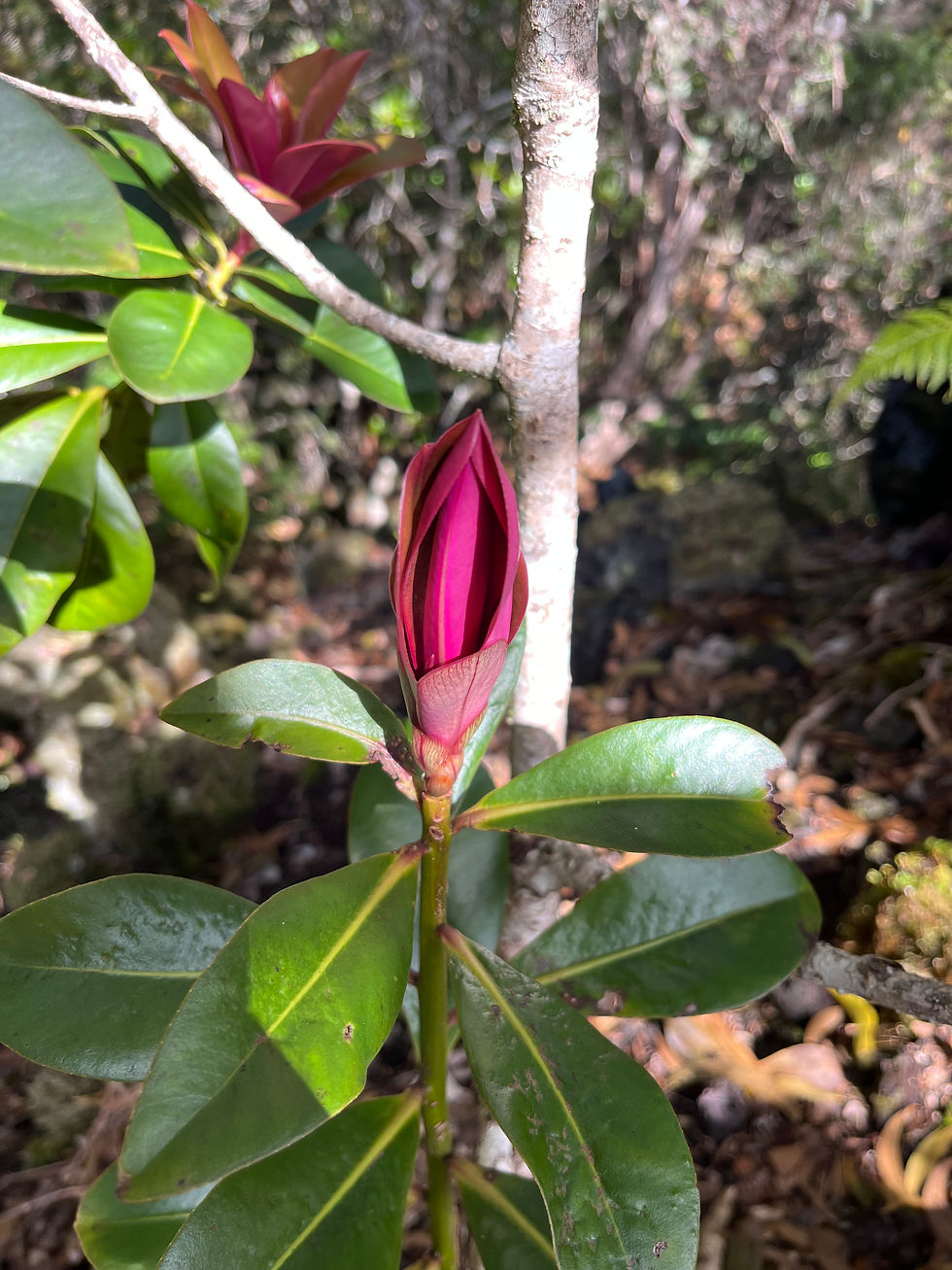
Liko at Pu'u O'o - Credit: Kai Garcia-Tobar

Liko at Pu'u O'o - Credit: Kai Garcia-Tobar
Cultural Significance
Kōlea Lau Nui had many uses in ancient Hawai’i. Hawaiians used Kōlea Lau Nui’s strong wood to make kapa anvils, house posts, beams, and canoe gunwales. Its bark was boiled and used to make a dark red kapa dye called hili kōlea, and its burned wood was used to make a black kapa dye. Its purple berries were also used as dye for kapa. Today, Kōlea Lau Nui wood is sometimes used in woodworking.

Kōlea Lau Nui in the Kohala Mountains - Credit: Kai Garcia-Tobar
Threats
Kōlea Lau Nui is considered “Vulnerable” by NatureServe, meaning there is a moderate risk of extinction due to its restricted range, relatively few populations, or recent declines. Like all native Hawaiian plants, Kōlea Lau Nui is threatened by fire, human development, invasive plants and insects, pigs, and rats.
Kōlea Lau Nui is an immensely beautiful and significant plant. It is our duty to be aware of it and to protect it so that it may continue to grow in the places it evolved to inhabit.
Cover photo: Liko at Pu'u O'o - Credit: Kai Garcia-Tobar


kolea lau nui more like COOLea lau nui
Woah the colors are so vibrant!