

Caravels: Exploration Ships of the 16th and 17th centuries
- Fiona Hamilton

- Dec 8, 2025
- 3 min read
How did people in the 1500s build

complex, giant, seaworthy ships without
machinery, using only their hands and a few
simple tools? During the 16th and 17th centuries, there was a flurry of people rushing across seas looking for treasure to bring back to their kingdoms. Any boats used on these journeys had to be able to withstand months on open ocean, hold enough supplies for the crew, and store whatever treasures or slaves they took on their voyage. The people who built these ships did so without machines and had no idea how far the ships would need to be able to travel.
Most ships built for exploration were caravels. Caravels were perfect for journeying towards unknown lands because they were fast, not so big as to be hard to maneuver, needed relatively small crews, and could travel long distances. And while not able to fight against larger warships that may seek to destroy them, their maneuverability and size let them get closer to land, where regular warships would quickly encounter rocks in the shallower waters.
Part of what made caravels so effective was their sails. Lateen sails, sails with a triangular shape, were incredibly useful and far more versatile than square sails. Square sails only worked when the wind was blowing towards where the crew wanted to go, becoming completely useless otherwise. Lateen sails could propel the ship in the desired direction even when the winds weren’t perfect for the crew. They could even make progress against a headwind by employing a zig-zag tactic.
Caravels (and other large ships) were built in shipyards –essentially yards with the specific purpose of holding ships that were in the process of being built.
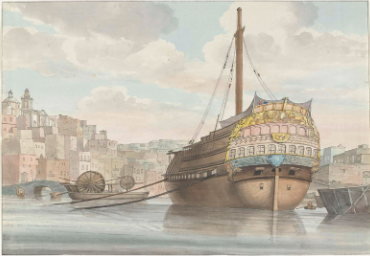
The smaller end of caravels weighed about 80 tons, the larger end nearing 150 tons. This was rather small compared to the multi-thousand-ton warships called galleons.
The first, and most important, part of the ship that was built was called the keel. The keel was the central beam of the ship on which everything else was built. The keel was made of a single tree that had been carefully hacked and smoothed into a large beam. The beam was then placed on a series of blocks, lifting the soon-to-be ship off the ground.
Next, the workers started on the front and back of the ship, then added ribs all along the keel. For the most part, people tried to use a single piece of wood for each part, but the ribs were large and needed to be curved, so they were made of three parts: the floor/flatter part, and the two arches that made the curve. Once they added a ‘whale’ to connect all of the ribs and made sure everything was as symmetrical as possible, the skeleton of the ship was complete.

The next step was filling out the shape of the ship. Giant wooden planks were added, all hacked and sanded down from trees that were over 65 feet tall. Because these planks were so big, simple nails couldn’t hold them in place. Instead, larger holes were made in the wood, and giant wooden nails were hammered in, connecting the planks to the ribs. The floors were added next, creating the foredeck, quarterdeck, maindeck, and poopdeck. (Not literally a deck for pooping)
Unfortunately, just because it looks like a boat, it does not mean it will act like a boat. At that point in the process, the caravel was nowhere near seaworthy. No matter how meticulous a building crew was, there would always be gaps between the planks, not to mention that wood itself isn’t exactly waterproof. So tar-soaked rope was placed between the planks, and more tar was coated on top, sealing the boat completely.
Then, they essentially had a giant rowboat; it could go on water, but they still needed sails. All caravels had lateen sails, but some also had square sails. The former was called caravela latina, and the latter, caravela rotunda. The caravela rotunda was very much like the current-day picture of boats meant for exploration… or pirating.
With these ships, Europeans of the 16th and 17th centuries raced around the world, looking for new lands, treasures, and spices. Two of Christopher Columbus’s fleet were caravels, the Niña and the Pinta. A caravel generally hosted a crew of twenty, which, of course, diminished over the course of any given voyage.

The building of caravels and other ships of that century required lots of skill and talent, and access to large forests of giant trees that no longer exist today (partly because of all the shipbuilding). Both complex and simple, the caravels were by far one of the most important ships of the time.
Sources:
About caravels: World History Encyclopedia
About galleons: World History Encyclopedia
Photos: Look and Learn


Comments